Thumbtacks, often perceived as everyday items of little relevance, hide a rich history and surprising versatility in multiple contexts. From their invention, fundamentally to fix plans and documents, to their use in decoration, packaging, or even in industrial applications, these small metal objects with flat heads have evolved in materials, designs, and functionalities. Understanding their characteristics, types, and applications helps to appreciate their importance and to select the most appropriate option for each need, optimizing fastening and ensuring durability.
Key takeaways
- Thumbtacks are essential fastening elements with diverse applications.
- There are multiple types of thumbtacks, varying in material, shape, and purpose.
- Choosing the right thumbtack depends on the material to be fastened and the anchoring surface.
The thumbtack: a universal fastening element and its origins
The history of the thumbtack dates back to the late 19th and early 20th centuries, a period in which the need to fix papers, plans, and samples to soft surfaces, such as cork boards or wood, became increasingly evident in offices and workshops. Although its concept is simple, its impact on the organization and presentation of information was significant, allowing for temporary and reusable fastening without the rigidity of nails or permanent adhesives.
Generally, a thumbtack consists of two essential parts: a flat head, which is usually metal or plastic, and a sharp point, almost always made of metal, which allows for insertion into the material. This simplicity is precisely what gives it its functionality and durability. The head provides a support surface for the finger when inserting it and a base for extraction, while the metal point ensures efficient penetration and a firm grip.
Historical fact
The patent for the modern thumbtack is attributed to Edwin Moore in 1900, who founded the Moore Push-Pin Company to market it.
Materials and manufacturing of thumbtacks
The selection of materials in the manufacturing of thumbtacks is crucial for their performance and durability. The point, due to its function of perforation and anchoring, is usually made of steel. This metal offers the ideal combination of hardness for penetration and corrosion resistance to last over time. Galvanized or nickel-plated steel are common options that add protection against oxidation, especially in humid environments.
As for the head, the diversity is greater:
- Nickel-plated steel or brass: Provide a shiny and resistant finish, common in traditional thumbtacks.
- Plastic: Polystyrene (PS) or polypropylene (PP) are frequent materials for the heads of colored thumbtacks. They offer lightness, chromatic variety and are usually more economical. The versatility of polypropylene, for example, is already known in other areas such as containers and packaging, and its use in this type of office product is widespread.
- Wood: In more decorative or ecological versions, wooden heads, such as beech or pine, can be found, attached to metal points.
The manufacturing process begins with the shaping of the metal points, generally by stamping or cold forging the wire. Subsequently, these points are assembled with the heads, either metal (by welding or riveting) or plastic (by injection or molding over the metal). Final finishes include anti-corrosion treatments or color applications for plastic heads.
Types of thumbtacks and their applications
Although the basic design of the thumbtack is simple, its evolution has led to a variety of types, each optimized for specific uses. The proper choice of a thumbtack can make a difference in the security of fastening, aesthetics, or functionality.
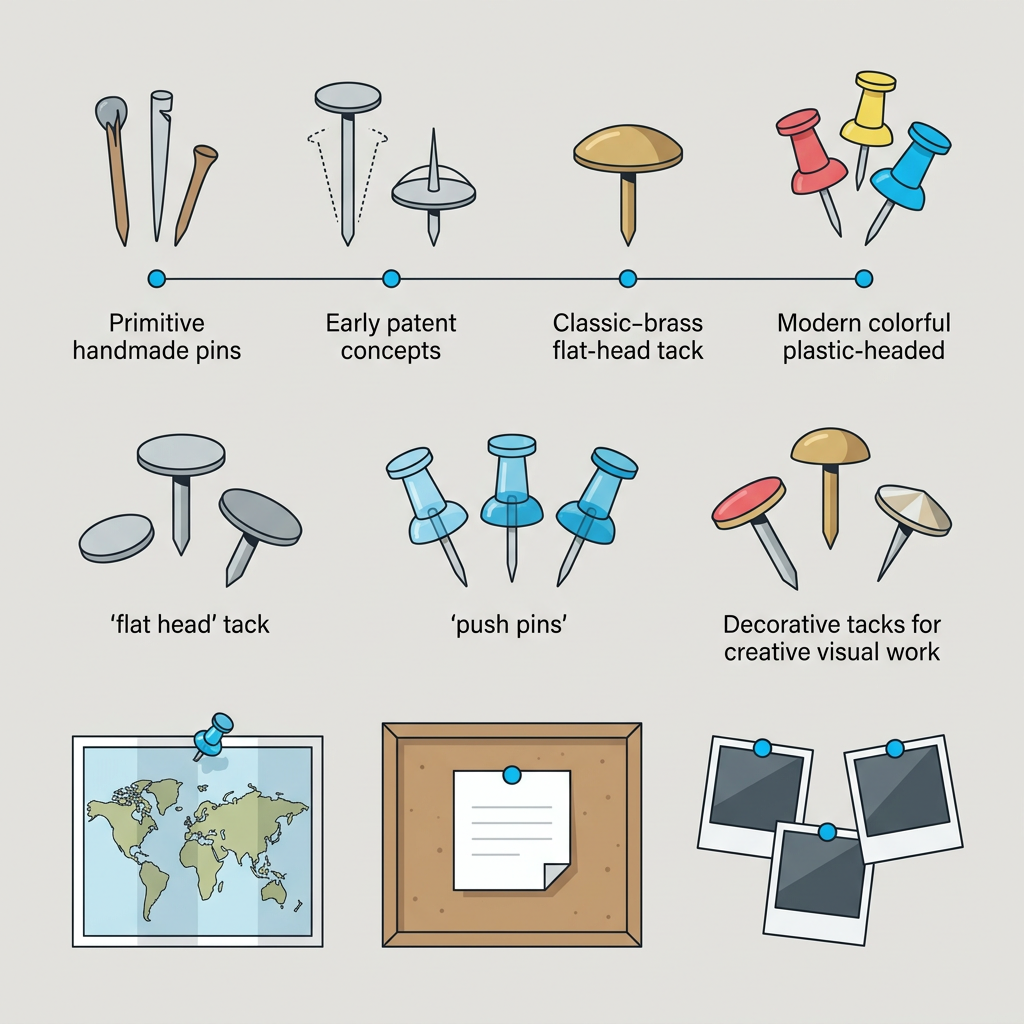
| Thumbtack Type | Main Characteristics | Common Uses |
|---|---|---|
| Flat thumbtack (classic) | Metal head (brass, nickel-plated steel) or plastic, short point. | Fastening papers to cork boards, documents, maps. Suitable for soft surfaces. |
| Plastic head thumbtack (Push Pin) | Large, ergonomic colored plastic head, longer point. | Ideal for easy handling, organizing by colors, fastening multiple sheets or thicker materials. School projects, decoration. |
| Decorative thumbtack | Heads of various shapes and materials (flower, star, wood, glass). | DIY projects, scrapbooks, space decoration, inspiration boards. |
| Upholstery tack | Hemispherical head, often metallic (brass, steel), more robust point. | Fastening heavy fabrics to furniture, upholstery decoration, antique restoration. |
| Map pin | Small round head, often colored plastic, fine point. | Marking locations on maps, route planning, geographical data visualization. |
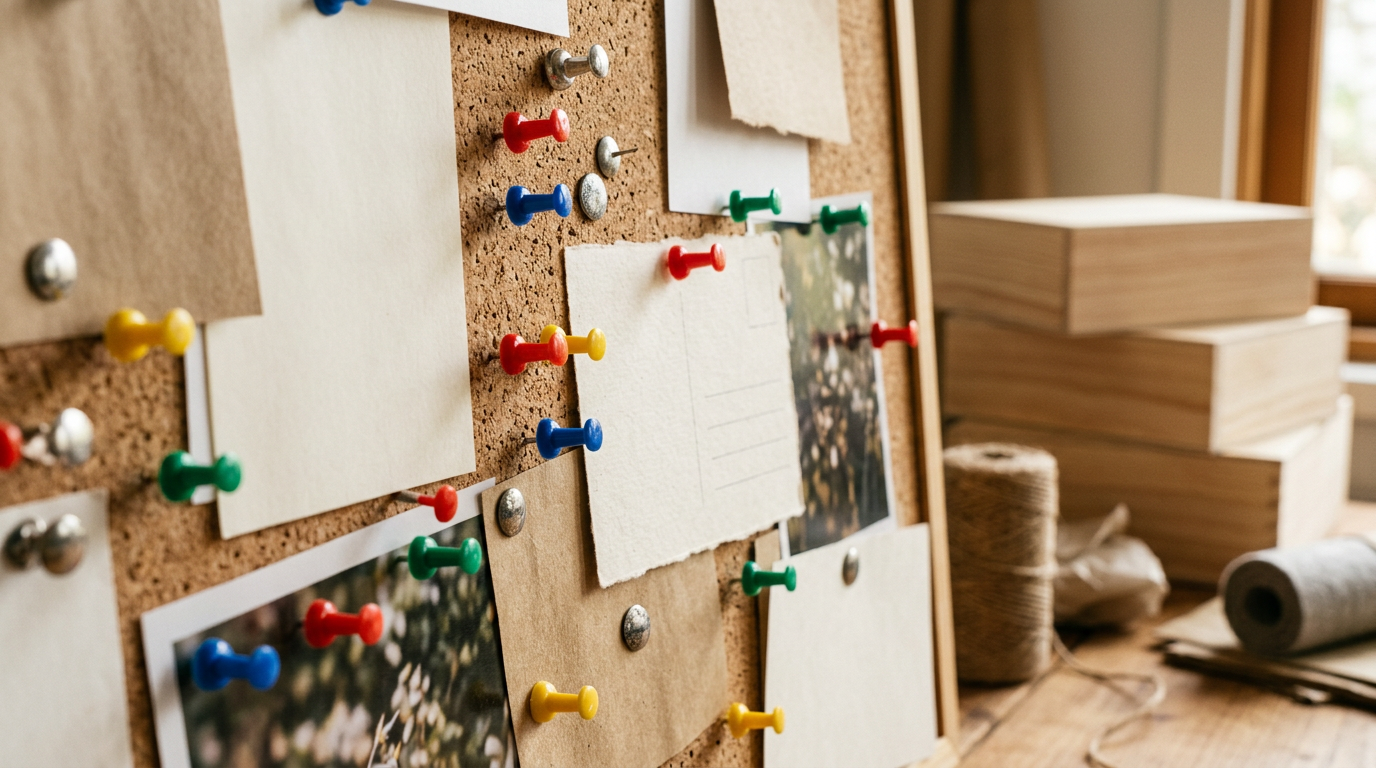
The versatility of thumbtacks extends beyond the office. In the field of packaging and premium gifts, although they are not a direct component of the wrapping, they can be used to temporarily fix labels in production, or for layout tests of personalized wooden box designs before final production. In decoration, they allow creating visual murals, fixing garlands, or displaying photographs without permanently damaging surfaces. Their low cost and ease of use make them a practical option for multiple scenarios.
- Easy to useRequires minimal effort for application.
- ReusableAllows multiple fastening and extraction cycles.
- EconomicalLow-cost fastening solution.
- VersatileAdaptable to multiple surfaces and light materials.
Tips for choosing and correctly using thumbtacks
The selection of the appropriate thumbtack and its correct use are essential to guarantee the stability of the fixed objects and avoid damage to both the material and the anchoring surface. Here are some criteria and practical recommendations:
Key considerations when choosing thumbtacks
- Type of material to be fastened: If it is thin papers, traditional flat thumbtacks or map pins are usually sufficient. For several sheets, cardboard, or denser materials, plastic head thumbtacks with longer and more robust points are more appropriate, as they offer a larger gripping surface.
- Anchoring surface: Thumbtacks are designed for soft surfaces such as cork, soft wood, foam boards, or cardboard. They are not suitable for drywall without prior anchoring, brick, or metal, where their point would bend or not penetrate.
- Aesthetics and purpose: For exhibitions or decoration where appearance is valued, decorative thumbtacks or colored plastic head thumbtacks can complement the design. In purely functional environments, classic or standard plastic head thumbtacks are the best option.
- Frequency of handling: If they are to be removed and reinserted frequently, large plastic head thumbtacks are more comfortable and safer to use, as they minimize the risk of punctures.
Safety tip
When removing a thumbtack, gently twist the head while pulling to facilitate extraction and minimize damage to the material and anchoring surface.
Common mistakes and how to avoid them
- Excessive force: Pushing a thumbtack with too much force on a hard surface can bend the point or cause the head to detach. Make sure the surface is suitable.
- Use on unsuitable surfaces: Trying to use thumbtacks on metal, glass, or brick walls is not only ineffective but can damage the thumbtack and the surface. For these cases, there are options such as staplers for upholstery or adhesive fastening systems such as cello tape or masking tape, or even nails.
- Careless storage: Leaving thumbtacks loose can cause accidental punctures. Storing them in a small wooden box, a closed container, or a specific organizer is the safest.
- Overload: Using a single thumbtack to hold objects that are too heavy or bulky will result in unstable fastening or the object falling. Distribute the weight with several thumbtacks or use a more robust fastening method. If the packaging or premium gift is of great value, it is essential that the thumbtack is not the only joining method to ensure total integrity.
"The simplicity of a thumbtack is inversely proportional to the magnitude of the problems it can solve in daily organization."