Boxes for Christmas? Order as early as you can: the factory gets overloaded and lead times get longer.Last day to order up to 1,000 boxes: 25 October 2026.See all deadlines
Cardboard folders: functionality, design and versatility in document organization. In the field of office organization, corporate presentation and the storage of creative projects, cardboard folders continue to be an essential tool. Far f
Cardboard folders: functionality, design, and versatility in document organization
In the fields of office organization, corporate presentation, and the storage of creative projects, cardboard folders continue to be an essential tool. Far from being mere paper containers, these items combine the simplicity of a traditional material with the aesthetic and functional demands of today's environment. Whether for archiving files in a consultancy, delivering memorable cost estimates to clients, or structuring the content of an educational dossier, choosing the right support makes the difference between an ordinary presentation and a memorable experience that conveys professionalism and order.
Key takeaways
Cardboard folders offer a perfect balance between sustainability, durability, and aesthetic versatility.
Multiple formats are available: with flaps, rings, elastic bands, or pockets, adapted to every archiving or transport need.
The choice of grammage and the type of paper or cardboard directly determines the folder's durability.
Surface finishes allow you to customize the design to reinforce visual identity or the presentation of a corporate gift.
The current market offers a very wide variety of options ranging from classic elastic-band folders for daily use to sophisticated rigid cases designed to protect high-value documentation. Understanding the technical characteristics of each model helps you make sound decisions, optimizing both your budget and the visual impact of the chosen support. Throughout this analysis, we will delve into material types, selection criteria, finishing options, and the most common mistakes to avoid.
Types of cardboard folders by use and structure
The architecture of a folder defines its functionality. A file folder meant to store invoices for years does not require the same structure as a presentation folder designed for a single-day event. Identifying the correct format simplifies daily workflow and ensures the physical integrity of your documents.
Classification by purpose
Choosing between folders with flaps, rings, or gusseted systems depends directly on the volume of sheets and the frequency with which the content needs to be accessed.
Among the most common models, the following stand out:
Folders with flaps and elastic bands: Ideal for daily transport of loose sheets. The flaps prevent documents from sliding out the sides, while the elastic bands ensure a firm closure.
Ring binders: Designed for long-term archiving. They allow you to incorporate plastic sleeves, dividers, and hole-punched paper to organize by categories or dates.
Folders with pockets and business card holders: Widely used in the commercial sector to deliver proposals, contracts, or welcome dossiers. Their interiors usually include specific die-cuts to insert business cards.
Three-flap folders with a tab closure: An elegant and minimalist alternative that dispenses with elastic elements, opting for a clean and quick fit.
Materials and grammages: the foundation of durability
Cardboard is not a homogeneous material. Its behavior regarding use, moisture, and the passage of time varies drastically depending on its composition, grammage, and the treatment received during manufacturing. When evaluating a batch of folders, it is advisable to pay attention to the following technical aspects.
FSCCertified paper
100%Recyclable
300gStandard minimum grammage
For corporate and commercial applications, grammages usually range between 300 g/m² and 400 g/m² on graphic cardstock or coated cardboard supports. When superior rigidity is sought—similar to the rigid cases used in the gift sector or in contexts where eCommerce packaging demands maximum protection—compact cardboard or greyboard lined with printed paper is used.
Likewise, growing concern for the environment has driven the use of kraft papers and unbleached recycled cardboards. These materials not only provide a natural, organic aesthetic highly valued in modern design, but they also guarantee responsible forest management through official certifications.
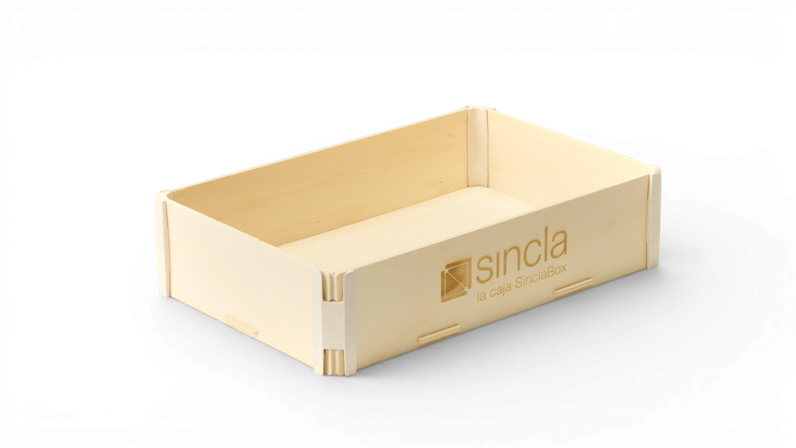
Custom wooden boxes
Discover our wooden boxes for packaging, hospitality, events and more. In-house manufacturing and full customisation.
A neutral cardboard folder serves a strictly utilitarian function, but when customized, it becomes a powerful visual communication tool. Printing techniques and special finishes allow you to transform a flat surface into a sophisticated product.
Offset and digital printing: Ideal for reproducing photographs, complex patterns, and full-color corporate logos with great definition.
Stamping or debossing/embossing: Adds relief or metallic finishes (gold, silver, bronze) to specific areas, elevating the perceived value of the item.
Gloss or matte lamination: Protects the surface against scuffs, moisture, and fingerprints, significantly extending the folder's lifespan.
Selective UV varnish: Creates a very attractive visual and tactile contrast by combining matte finished areas with localized glosses.
Design tip
If you opt for matte lamination, selective varnish spectacularly highlights logos or main titles thanks to the contrast of textures.
Criteria for choosing the right cardboard folder
Given the wide variety of alternatives available on the market, it is easy to get lost in purely aesthetic details and overlook critical functional aspects. To make the right choice, it is best to follow a methodical process based on key questions.
Define the document volume. Estimate the average number of sheets the folder will hold to determine the spine width and the need to incorporate gussets or rings.
Analyze the frequency of use. Assess whether the product will experience daily transit in backpacks and briefcases or remain static on a permanent archive shelf.
Establish the communicative purpose. Differentiate between internal use (office organization) and external use (commercial presentations, project delivery, or public events).
Verify paper format compatibility. Ensure the interior dimensions slightly exceed the standard DIN A4 format or required size to prevent document edges from bending.
"The quality of the material support in a professional presentation acts as a silent preamble that anticipates the rigor of the content it holds."
Common mistakes when buying and designing cardboard folders
In corporate stationery projects and when purchasing archiving materials, it is common to make certain mistakes that directly affect the durability or visual outcome of the final product. Knowing them helps prevent them in advance.
Ignoring the grain direction of the cardboard: If folding is done against the grain, the cardboard may crack and lose rigidity at the main creases.
Choosing an insufficient grammage: Using cardstock that is too thin for folders with flaps and intensive use causes corners to bend quickly and tabs to break.
Saturating the exterior design: Forgetting safety margins and placing text or logos too close to cut lines or folding lines can ruin the finish after die-cutting.
Overlooking the closure system: Failing to provide elastic bands or adjustment flaps on folders intended for transporting multiple loose documents.
Caution with die-cuts
Before printing large runs of custom folders, it is essential to request a mock-up or unprinted white sample to verify that the folds and flaps fit together perfectly.
Frequently asked questions
What is the difference between a folder with flaps and a ring binder?
Folders with flaps are designed to transport or temporarily store unbound sheets, offering flexibility and speed. Ring binders, on the other hand, require hole-punching the paper and are designed to store large volumes of documentation permanently and neatly.
What cardboard grammage is most recommended for daily use?
For everyday use that includes transport in bags or briefcases, a minimum grammage of 350 g/m² is recommended, featuring a laminated finish that protects the cardboard against scuffs and environmental moisture.
Are folders with lamination or metallic details recyclable?
The vast majority of cardboard folders are manufactured with recyclable and biodegradable materials. However, plastic laminates and metallic stamping finishes may require specific separation processes at recycling plants, which is why ecological alternatives with biodegradable varnishes exist for projects with strict environmental criteria.
How should cardboard be stored to prevent it from warping?
Cardboard is a hygroscopic material, meaning it absorbs moisture from the environment. It should be kept in dry, well-ventilated spaces, away from direct sunlight, and stacked flat to prevent deformation in the flaps and spines.