Masking tape: uses, types, and essential characteristics for professionals and enthusiasts
Masking tape, also known as painter's tape, is an indispensable item in a wide variety of jobs, from protecting surfaces in painting processes to more creative and packaging applications. Its popularity lies in its ability to temporarily adhere to various surfaces and remove without leaving residue, a characteristic that differentiates it from other types of adhesive tapes. Understanding its properties, the different types available, and best practices for its use is essential to ensure optimal results and avoid common problems such as paint bleed or adhesive residue.
Key takeaways
- Masking tape is defined by its pressure-sensitive adhesive and easy, residue-free removal.
- Specific types exist for different temperatures, durations, and surface types.
- Correct application and removal are crucial to avoid damage or poor results.
- Its versatility ranges from painting and crafts to packaging and organization.
Origins and evolution of masking tape
The history of masking tape dates back to the 1920s, when Richard Drew, a 3M employee, observed automotive painters struggling to mask edges with butcher paper and strong adhesives that damaged paint. His solution was to develop a tape with a softer adhesive that was strong enough to stay in place, creating what we now know as painter's tape. This invention revolutionized automotive finishing techniques and quickly spread to other fields such as construction, decoration, and arts, establishing itself as a universal tool.
Since then, masking tape has evolved considerably. Manufacturers have developed more sophisticated adhesives and backings to adapt to specific conditions, such as high temperatures, prolonged UV sunlight exposure, or the need for an extremely sharp separation line. This constant innovation ensures that professionals and hobbyists have the right tool for every challenge.
Composition and fundamental characteristics
Typical masking tape consists of two main components: a backing and an adhesive. The combination of these elements determines its properties and performance in different applications.
The backing
The backing is the base of the tape and is usually made of crepe paper, a cellulose that gives it flexibility and tear resistance. Crepe paper, being slightly elastic, allows the tape to conform to curves and contours without breaking or deforming. The most common color is white or a light beige tone, although it can be found in other colors for specific applications (for example, green or blue for outdoor or longer-lasting uses).
- Crepe paper: Offers flexibility, conformability, and a matte surface that facilitates writing. Its texture allows for smoother application and reduces the risk of bubbles.
- Thickness: Varies by use. Thicker tapes are generally more resistant to paint bleed and easier to handle on large surfaces.
The adhesive
The adhesive is the key differentiating factor of masking tape. Generally, it is a pressure-sensitive rubber adhesive, formulated to provide sufficient adhesion without being excessively aggressive. This characteristic allows for clean removal, without leaving sticky residue or tearing off the underlying surface.
- Adhesion level: Ranges from low (for delicate surfaces like wallpaper or fresh paint) to medium-high (for textured walls, untreated wood, or metal).
- Temperature resistance: Some tapes are designed to withstand high temperatures (e.g., in paint baking processes), while others are formulated for optimal performance at room temperature.
- Clean removal time: This is a critical parameter. Tapes are specified for a certain period (e.g., 14 days, 21 days) during which they can be removed without leaving residue. Exceeding this time, especially with UV exposure, can cause the adhesive to degrade and adhere permanently.
- UV resistance: Essential for outdoor work, where the tape will be exposed to sunlight. Without this resistance, the adhesive can dry out, crack, and become difficult to remove.
Key Adhesion
Masking tape adhesion is measured in Newtons per inch (N/in) and can vary significantly between products, directly impacting its suitability for specific surfaces.
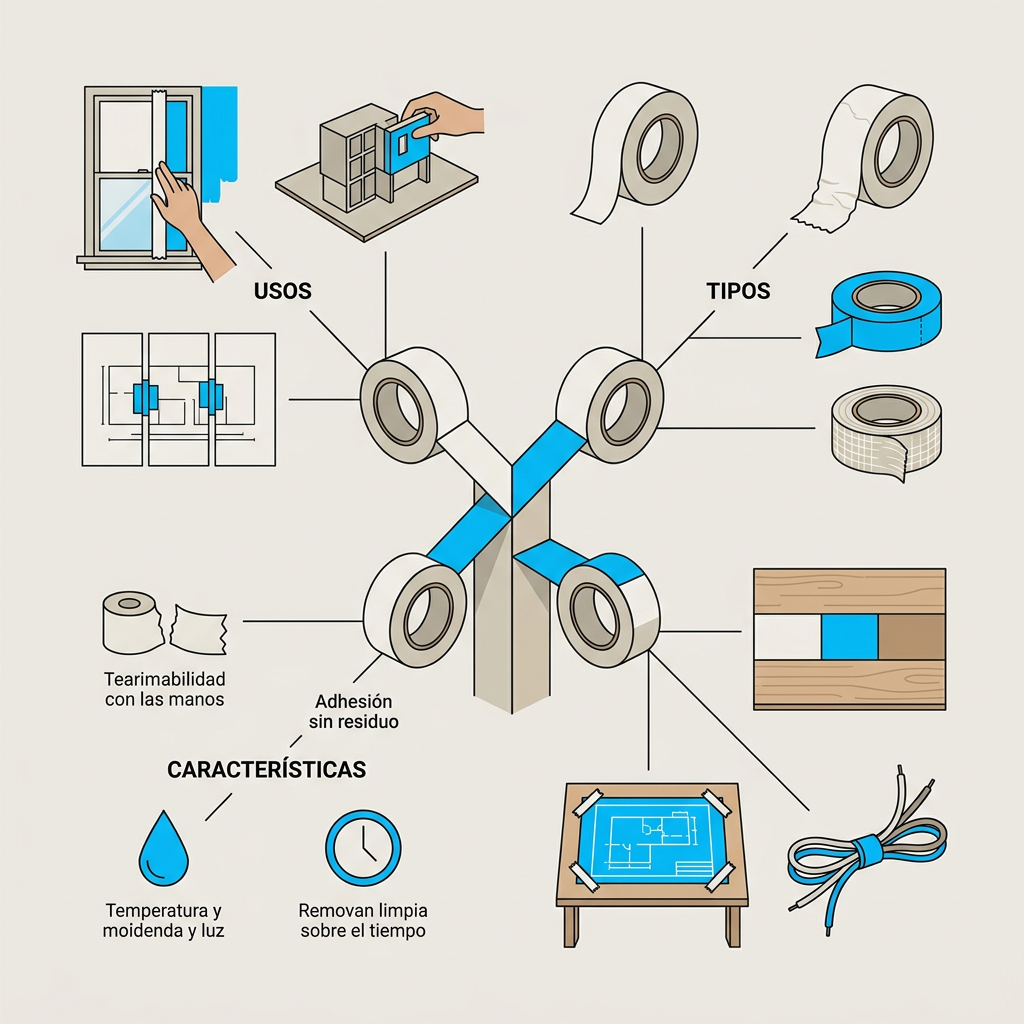
Types of masking tape and their specific applications
Although most people associate masking tape with painting, the market offers a specialized range for different needs. Choosing the right tape is as important as the application technique.
- StandardFor general indoor painting, short-term use.
- Low adhesionIdeal for delicate surfaces like wallpaper, fresh plaster, or recently dried paint.
- High adhesionFor rough surfaces, stucco, brick, or where greater security is required.
- UV resistantDesigned for outdoor use, withstands prolonged sun exposure without degradation.
- High temperatureFor industrial processes or coatings that require oven curing.
- Clean edgeIncorporates "Block Out" technology for an ultra-sharp paint line.
Key applications
- Painting and decoration: This is its best-known use. It protects moldings, window frames, baseboards, and ceilings when painting walls. Key for creating straight lines and geometric patterns.
- Automotive: Used to mask vehicles during repainting, protecting areas that should not be sprayed or that have different colors. Withstands baking temperatures.
- Crafts and art: Allows for creating clean edges on canvases, models, or DIY projects. It is also used to temporarily fix elements or as a stencil.
- Light packaging and bundling: Although it is not a tape for sealing heavy boxes like adhesive tape for packaging, masking tape is useful for bundling light objects, temporarily closing packages, or labeling.
- Labeling and organization: Its paper surface allows easy writing, making it excellent for labeling moving boxes, tools, or containers.
Application and removal techniques for professional results
A good result with masking tape not only depends on product quality but also on correct application and removal.
Surface preparation
- Cleaning. Ensure the surface is clean, dry, and free of dust or grease. Dirt can prevent good adhesion and cause paint leaks.
- Temperature. Apply tape at room temperature (ideally between 10°C and 38°C). Extreme temperatures can affect adhesive performance.
Application
- Step one. Unroll the tape slowly, applying even pressure as you go. It is better to apply shorter, overlapping sections than one very long one.
- Step two. Press the edge firmly. Use a putty knife or your finger to ensure the tape edges are well-adhered and sealed, preventing paint from bleeding underneath.
- Step three. Overlapping. If you need to cover a very wide surface, slightly overlap the edges of the tape strips to avoid gaps.
The angle trick
For a perfect paint line, apply a very thin coat of the base color over the edge of the tape before applying the main color. This seals the edge, and any bleed-through will be the same base color, imperceptible.
Tape removal
- Step one. Timing is key. Remove the tape while the paint is still slightly wet (but not soaked) for the cleanest lines. If the paint dries completely, it might lift with the tape.
- Step two. Removal angle. Pull the tape at a 45-degree angle, slowly pulling backward and away from the freshly painted surface. This minimizes the risk of paint peeling off.
- Step three. Gentle motion. Avoid sudden jerks. If the tape resists a lot or the paint starts to lift, you can use a fine utility knife to cut the paint along the tape's edge before pulling.
Patience in removing masking tape is as vital as precision in its application to achieve an impeccable finish.
Common mistakes and how to avoid them
Even with a quality product, mistakes in using masking tape can ruin a project. Here are the most frequent ones:
| Common Mistake | Consequence | Solution / Prevention |
|---|---|---|
| Not choosing the right tape | Insufficient adhesion, surface damage, residue, bleed. | Select tape according to surface type, duration, and exposure (UV, temperature). |
| Dirty or wet surface | Tape does not adhere correctly, paint bleeds. | Clean and dry the surface completely before applying tape. |
| Not pressing the edges | Paint bleed under the tape, uneven lines. | Ensure that the entire length of the tape edge is well sealed. |
| Leaving tape on too long | Adhesive dries and hardens, leaving residue or damaging the surface upon removal. | Respect the clean removal time specified by the manufacturer. Remove as soon as the paint is "tack-free." |
| Removing tape when paint is dry | Paint can lift off with the tape, leaving jagged edges. | Remove tape while paint is still slightly wet. If already dry, gently heat with a hair dryer before slowly pulling can help. |
| Applying tape over freshly painted surfaces | Paint can lift when the tape is removed. | Wait for the paint to dry thoroughly before applying tape over it. Use low-adhesion tapes. |
Sustainability and environmental considerations
In a world increasingly aware of environmental impact, the adhesive tape industry has also begun to address sustainability. While traditional masking tape is a single-use product, manufacturers are exploring alternatives:
- Recycled materials: Crepe paper backing may contain a percentage of recycled material.
- Water-based adhesives: Instead of solvents, some adhesives use water-based emulsions, reducing Volatile Organic Compounds (VOCs).
- Sustainable packaging: Reducing plastic use in packaging or using recycled/recyclable materials.
While it is often difficult to find completely "green" masking tapes due to technical performance requirements, the trend towards more environmentally friendly options is growing.
Trends and innovation in the sector
The masking tape market does not stand still. Innovations seek to improve efficiency and the quality of finishes:
- Ultra-precision tapes: With thinner backings or special adhesive treatments, they achieve unparalleled paint lines, ideal for detailed work or complex graphics.
- Tapes with integrated dispenser: Facilitate application, especially in large areas, and ensure a clean, uniform cut.
- Tapes for specialized surfaces: Continuous developments for difficult surfaces such as concrete, glass, or advanced composite materials.
Choosing the right masking tape for each project is a small detail that can have a significant impact on the final result, ensuring clean and professional finishes and saving time and effort.