Industrial Shelving: A Complete Guide to Optimizing Storage
The essentials
- Industrial shelving optimizes storage space and improves logistical efficiency.
- There are various types of shelving, each adapted to different load, access, and rotation needs.
- Safety and current regulations are crucial in the design and installation of shelving systems.
Types of industrial shelving: adaptability for every need
Conventional or Pallet Racking (Selective Rack)
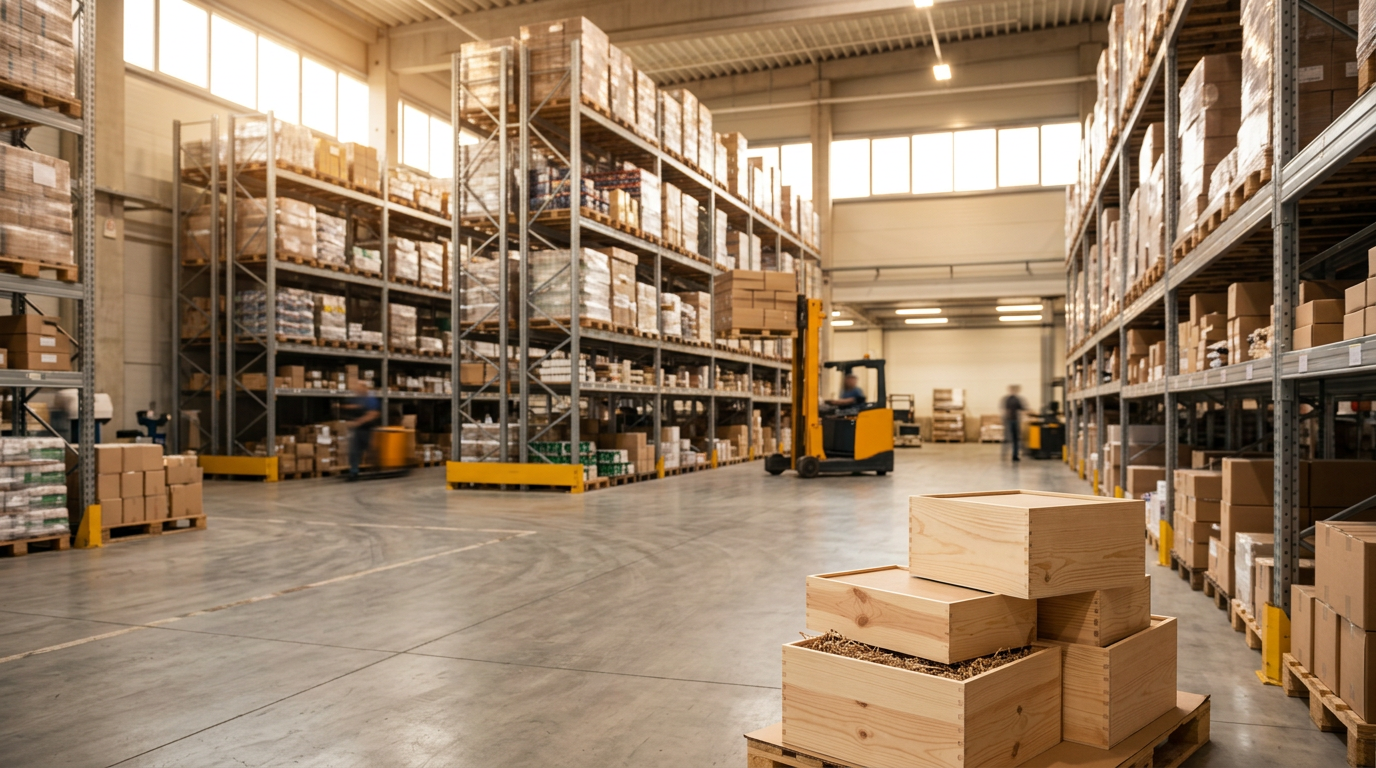
This is the most common and versatile system. It allows direct access to each pallet, making it ideal for warehouses with a wide variety of references and medium to high rotation. Its modularity allows it to adapt to different pallet sizes and warehouse heights.
- Advantages: Direct access to each pallet, easy reconfiguration, suitable for warehouses with many references.
- Disadvantages: Requires wide aisles, low storage density compared to other systems.
Drive-in and Drive-through Racking
Designed to maximize in-depth space utilization, they are ideal for storing homogeneous products with high volume and few references. Forklifts enter directly into the racking structure to load or unload pallets.
- Drive-in: A single entry/exit aisle (LIFO system - Last In, First Out).
- Drive-through: Separate entry and exit aisles (FIFO system - First In, First Out), allowing for better rotation.
FIFO/LIFO Optimization
Choosing between Drive-in (LIFO) or Drive-through (FIFO) directly depends on product expiration and rotation. An error in this choice can lead to obsolescence or stock loss.
Cantilever Racking
Specially designed for storing long and bulky loads such as pipes, profiles, timber, panels, or furniture. They consist of central columns with cantilever arms where the goods are supported. They can be single or double-sided.
Dynamic Racking (Gravity Flow Racking)
They use gravity to move pallets along inclined rollers. Pallets are loaded from one end and slide smoothly to the other, where they are removed. They operate on the FIFO principle, making them perfect for perishable products or those with high rotation.
Push-back Racking
They combine high storage density with good access to references. Pallets are stored in depth, one behind the other, on carts that slide on rails. When a new pallet is introduced, it "pushes" the previous ones to the back. It operates on the LIFO principle.
Mobile Racking (Movibloc)
Mounted on mobile bases that move on rails, they allow the working aisle to be opened only where needed. This maximizes space utilization, significantly reducing the area allocated to aisles. They are ideal for archives, cold rooms, or warehouses with low rotation but high volume.
Heavy-Duty Racking (Heavy Palletization)
Designed to support very heavy loads, these racks use reinforced profiles and structural elements. They are common in warehouses for coils, heavy molds, or large and heavy industrial components.
Picking or Manual Load Racking
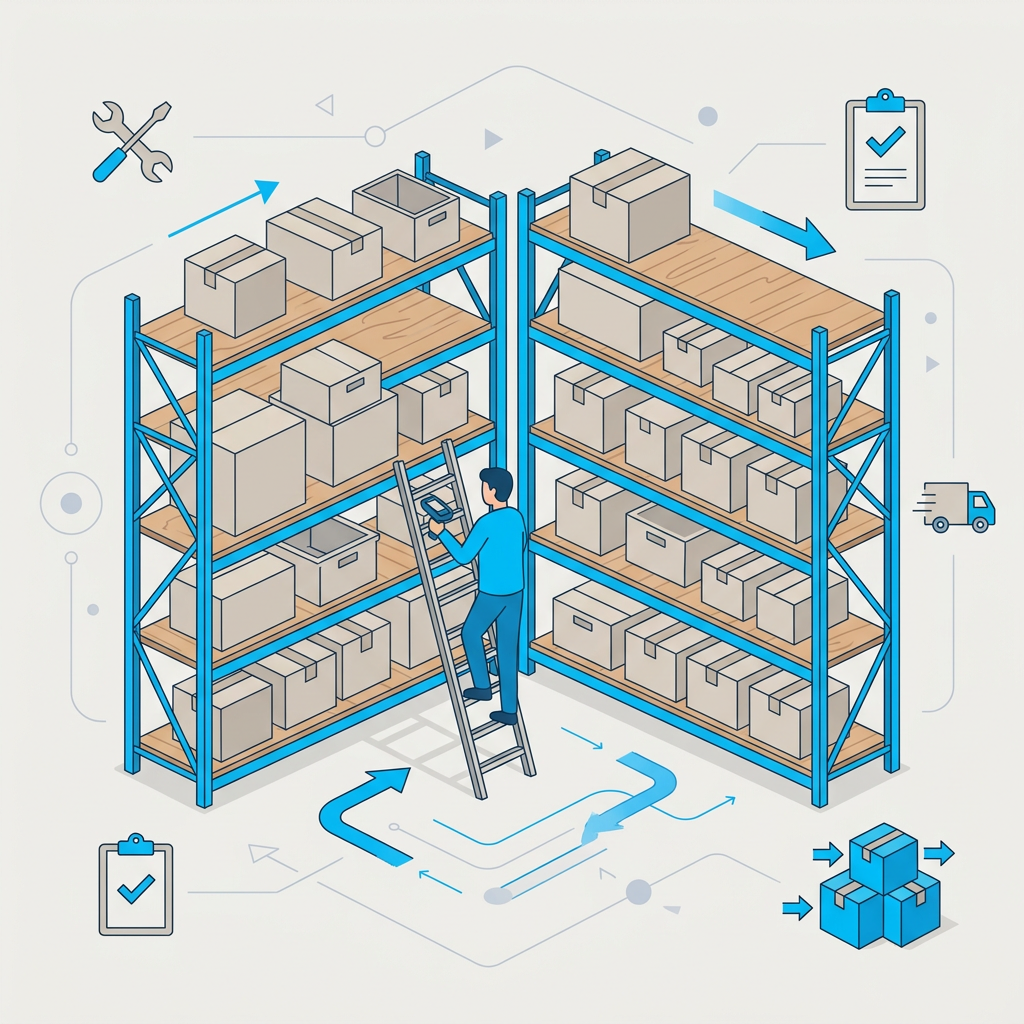
Aimed at lighter and smaller volume products that are handled manually, without the need for machinery. They allow a wide variety of configurations with adjustable shelves to adapt to different types of items and boxes, such as plastic storage boxes.
- VersatilitySuitable for a wide range of light products.
- AccessibilityEasy access to items for order picking.
- EfficiencyOptimize time in manual picking operations.
Mezzanines or Lofts
They are not shelves themselves, but structures that allow doubling or tripling the storage or work surface in a warehouse. Picking or pallet racking can be installed on them, creating different levels.
Materials and finishes in industrial shelving
- Steel: It is the predominant material due to its strength and durability. It can be cold-rolled or hot-rolled steel, depending on the load requirements.
- Finishes:
- Epoxy paint: Offers good corrosion resistance and an aesthetic finish.
- Hot-dip galvanizing: Provides excellent corrosion protection, ideal for humid or outdoor environments.
- Electro-galvanizing: Offers intermediate protection and a more uniform finish.
- Accessories: Elements such as mesh panels, separators, pallet stops, or upright protectors are crucial for safety and functionality.
Key factors for choosing industrial shelving
- Analyze product characteristics:
- Type of goods: Pallets, boxes, long items, coils, etc.
- Dimensions and weight: These will determine the load capacity and the dimensions of the shelving.
- Expiration and rotation: Influence the choice between FIFO and LIFO systems.
- Evaluate available space:
- Warehouse area and height: To optimize storage density.
- Floor characteristics: Load capacity and leveling.
- Location of doors, columns, and other obstacles.
- Consider handling equipment:
- Type of forklift: Counterbalanced, reach truck, pallet jack, etc. Their characteristics (lifting height, required aisle width) are decisive.
- Automatic systems: Stackers, conveyors, if applicable.
- Define workflows and operation volume:
- Number of pallets to store and daily movements.
- Picking speed and order preparation.
- Future expansion needs.
- Prioritize safety and regulations:
- Local and international regulations: Compliance with industrial safety standards.
- Certifications: Manufacturer's quality and safety standards.
- Protections: Guardrails, pillar protectors, anti-fall netting.
- Evaluate investment and return:
- Initial cost of the shelving system.
- Installation and maintenance costs.
- Expected benefits: Increased capacity, reduced times, improved safety.
Safety and maintenance considerations
Inspections and maintenance
It is crucial to carry out periodic inspections by qualified personnel to identify possible damage or deformation. These inspections should include:
- Daily or weekly visual inspection: By the warehouse staff themselves.
- Annual internal inspection: Carried out by a qualified company technician.
- Annual external inspection: Carried out by an independent expert, in accordance with regulations.
Mandatory safety elements
- Upright protectors: To prevent damage from forklift impacts.
- Floor anchors: Ensure the stability of the structure.
- Pallet stops: Prevent pallets from falling off the back.
- Safety nets: Protect against falling objects.
- Maximum load signage: Clear indication of the load capacity for each level and module.
Overload Risks
Exceeding the load capacity of shelving is one of the most common causes of serious accidents in warehouses. Respecting the manufacturer's instructions is vital.
Technology and automation in industrial shelving
- Automated warehouses: Shelving systems served by stacker cranes or mobile robots that manage the entry and exit of goods without human intervention.
- Radio shuttle systems: Motorized carts that transport pallets within the storage channels of Drive-in or Push-back shelving, improving density and speed.
- Warehouse management software (WMS): Allows real-time inventory control, optimizes product location, and plans picking routes, improving the efficiency of manual load or picking shelving.
Advantages of a well-designed industrial shelving system
- Space optimization: Maximum utilization of available surface and height.
- Improved organization: Facilitates product location and inventory management.
- Increased productivity: Reduces access and handling times for goods.
- Greater safety: Minimizes the risks of accidents and damage to products.
- Cost reduction: Decreases losses, optimizes labor, and energy consumption.
- Flexibility: Many systems allow reconfigurations to adapt to changes in storage needs.
Documentation and Certifications
Always ensure that the industrial shelving provider complies with the applicable safety certifications and regulations in your region, such as EN 15635 for the evaluation of storage equipment.