The metal cabinet: Durability, security, and versatile organization
The essential
- Metal cabinets offer high durability, security, and versatility for various environments.
- There are multiple types adapted to specific uses: office, industrial, changing room, etc.
- The correct choice depends on the material, locking system, load capacity, and security needs.
Types of metal cabinets: A solution for every need
Office cabinets
- Common features: They usually include adjustable shelves, key or combination locks, and finishes that complement office furniture. Some models are low-height, ideal for placing under windows, while others are tall and narrow to optimize vertical space.
- Applications: Document archiving, office supply storage, personal lockers for employees.
Industrial and storage cabinets
- Common features: Made with heavier gauge steel, structural reinforcements, heavy-duty shelves, and often more complex locking systems for added security. Some may be fire-resistant or corrosion-resistant.
- Applications: Storage of tools, spare parts, chemicals (with proper precautions and ventilation), heavy equipment.
Lockers and changing room cabinets
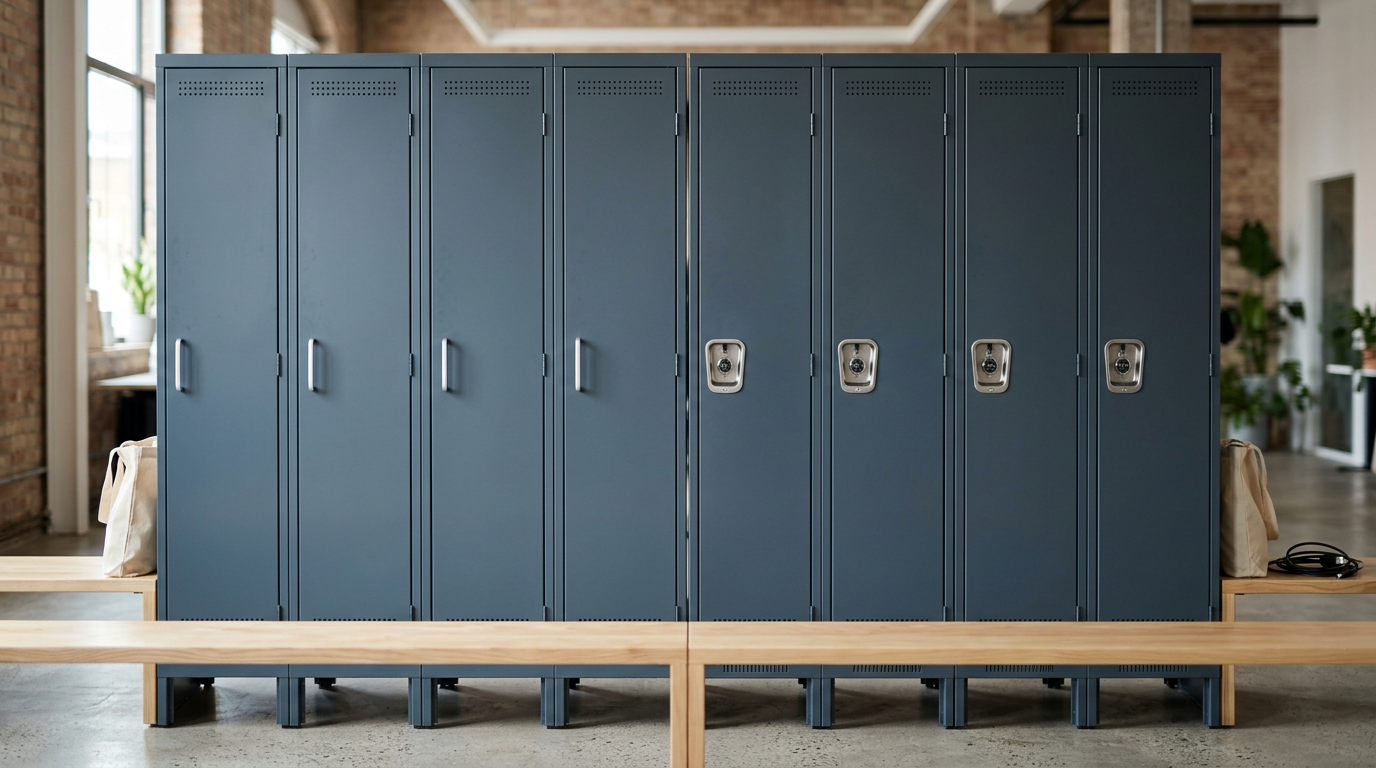
- Common features: Individual compartments, independent locks (key, padlock, code), ventilation to prevent odors and humidity, and often integrated benches or leg options.
- Applications: Staff changing rooms, sports centers, schools, temporary storage areas for visitors.
Key differences
The main distinction between types of metal cabinets lies in the material's resistance, internal configuration, and security systems, adapted to the level of protection and durability required by their usage environment.
Fireproof and security cabinets
- Common features: Double-wall construction with insulating material, intumescent seals that seal doors in case of fire, and high-security locks (electronic, mechanical combination, or double-bit key). They may have specific certifications for fire and burglary resistance.
- Applications: Protection of important documents (contracts, titles), digital media, cash, valuables.
Tool cabinets and integrated workbench
- Common features: Resistant work surface (wood, steel, resin), drawers with high-capacity telescopic slides, perforated panels for hanging tools, and lockable compartments.
- Applications: Mechanical workshops, carpentry shops, home garages, laboratories.
Materials and finishes: Beyond simple metal
Cold-rolled steel
- Thickness: Typically ranges between 0.6 mm and 1.5 mm. Office cabinets usually use finer gauges, while industrial ones require thicker gauges.
Stainless steel
Epoxy or powder coating
Galvanized finishes
0.6-1.5mm steel thickness
100%Recyclable steel
EpoxyStandard finish
Key factors to consider when choosing a metal cabinet
- Load capacityDetermine the total weight to be stored on each shelf and in the complete cabinet.
- Locking systemAssess the required security level: key, combination, electronic, with bolts or anchor points.
- Dimensions and spaceMeasure the available space and consider the internal dimensions for the objects to be stored.
- VentilationNecessary in lockers or cabinets that store clothes or products that may generate humidity or odors.
- MobilityConsider whether the cabinet will need to be frequently relocated; some models include wheels or pallet jack bases.
- AccessoriesAdditional shelves, drawers, clothes hanging rails, dividers, bins, internal lighting, etc.
Assembly and anchoring
industrial shelving unitAdvantages and disadvantages of the metal cabinet
Advantages
- Durability: Metal is a material resistant to impacts, scratches, and general wear, ensuring a long lifespan.
- Security: Most metal cabinets include locks, offering an additional layer of protection against unauthorized access or theft.
- Resistance to fire and pests: Unlike wood, metal is non-combustible and immune to pests such as termites or woodworms. Fireproof models offer active protection against fire.
- Easy maintenance: Its smooth surface allows for simple cleaning with a damp cloth.
- Versatility: They adapt to a wide range of uses and environments, from the office to the warehouse.
- Stability: Their weight and construction usually give them great stability, especially if properly anchored.
Disadvantages
- Aesthetics: Although they have improved, their appearance can be perceived as less warm or decorative than other materials in certain environments.
- Weight: They are usually heavier than cabinets made of other materials, which makes them difficult to move once assembled and loaded.
- Corrosion: Without proper treatment or finish, metal can rust in humid environments.
- Noise: Metal doors and drawers can be noisy if they do not have dampers or a good closing design.
- Price: High-end, fireproof models or those with special features may have a higher initial cost.
Optimize your choice
To maximize the lifespan and functionality of your metal cabinet, invest in models with quality epoxy paint finishes and consider anchoring for optimal security and stability, especially in dynamic environments.
Sustainability and the metal cabinet
Maintenance and care
- Regular cleaning. Use a damp cloth with neutral soap to clean the surface. Avoid abrasive products that could damage the finish.
- Lock and hinge inspection. Periodically lubricate locks and hinges with a suitable spray to maintain smooth operation and prevent rust.
- Damage inspection. Check for deep scratches or areas where the paint has lifted. Touch up with anti-corrosion paint if necessary to prevent oxidation.
- Do not overload. Respect the maximum load capacity specified by the manufacturer to avoid deformations in shelves and structure.
- Secure anchoring. Periodically check that the anchoring to the wall or floor remains firm, especially if the cabinet is frequently opened and closed or contains heavy objects.
Metal cabinets vs. other storage options
plastic drawer unit| Feature | Metal cabinet | Wood/MDF cabinet | Plastic cabinet |
|---|---|---|---|
| Durability | Very high, resistant to impacts and deformations. | Medium-high, can deform with humidity or strong impacts. | Low-medium, prone to breakage and deformation with load. |
| Security | High, robust locks and difficult-to-force structure. | Medium, less resistant locks, easier-to-manipulate structure. | Low, basic or nonexistent locks, fragile structure. |
| Fire resistance | High (especially fireproof models). | Low, combustible. | Low, flammable. |
| Maintenance | Low, easy cleaning. | Medium, requires special care for wood. | Low, easy cleaning. |
| Cost | Medium-high. | Medium-high (depending on wood type). | Low. |
| Aesthetics | Functional, modern. | Warm, traditional. | Functional, informal. |