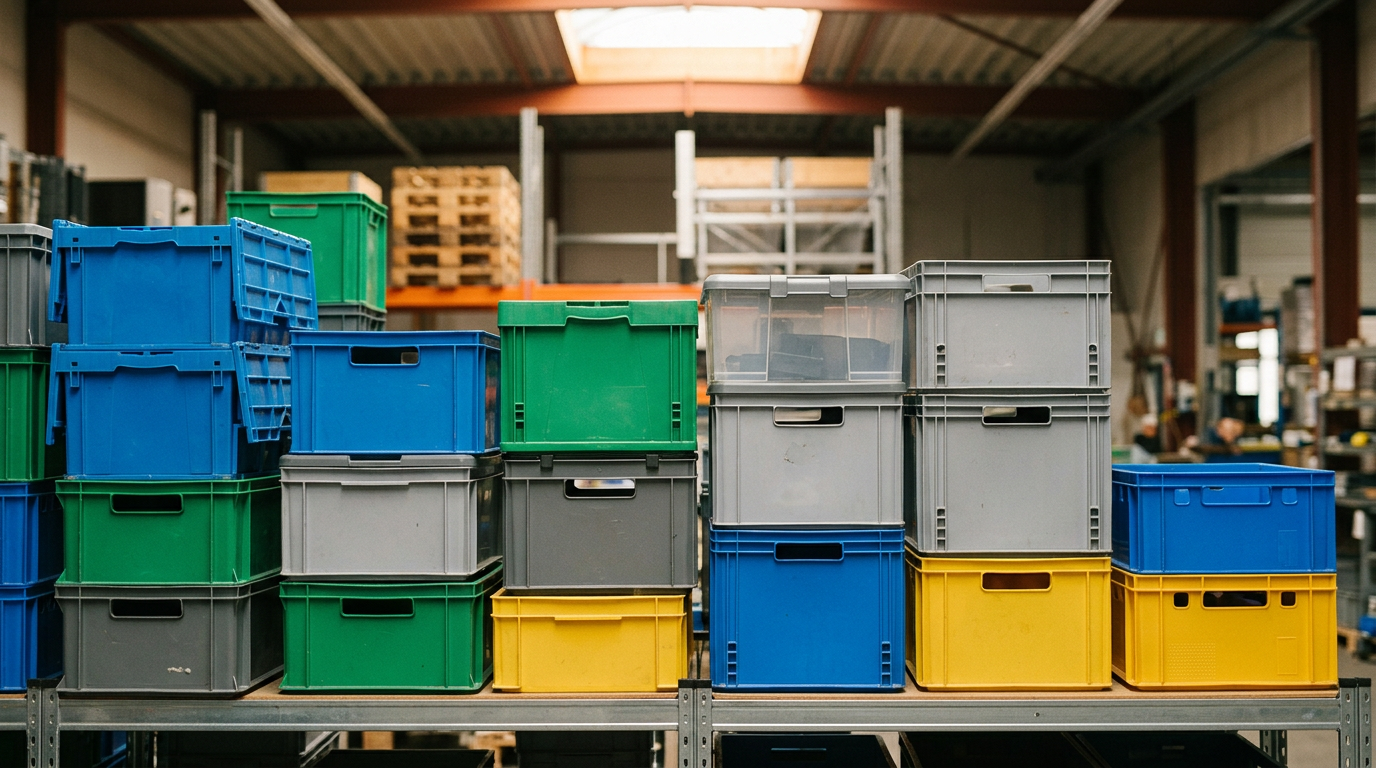
Plastic Boxes: Versatility and Resistance in Storage and Transport
The Essential
- Plastic boxes are essential for storage and transport due to their durability and versatility.
- There are various types of plastic (PP, HDPE, PET) that define the properties and uses of each box.
- Sustainability is key, with an emphasis on recycling and reuse to reduce environmental impact.
Common Materials in Plastic Box Manufacturing
To delve deeper into materials, you can consult the article on What is Polypropylene? Uses, Properties and Types of PP.
- Polypropylene (PP)Lightweight, resistant to chemicals and temperatures.
- High-density polyethylene (HDPE)Greater rigidity, good impact and moisture resistance.
- Polyethylene terephthalate (PET)Transparent, excellent barrier and recyclability.
- Polycarbonate (PC)Extreme impact resistance and high transparency.
Properties and applications of main plastics
- Polypropylene (PP): It is one of the most versatile plastics. It stands out for its lightness, fatigue resistance (ideal for integrated hinges), good chemical resistance, and its ability to withstand moderate temperatures. It is used in stackable boxes, food containers, packaging for electronic and automotive components. Its smooth surface facilitates cleaning, making it ideal for hygienic environments.
- High-density polyethylene (HDPE): Known for its high impact resistance, rigidity, and low moisture permeability. It is denser than PP and is often used in larger and more robust boxes, such as agricultural pallets, industrial containers, or liquid transport boxes. It is resistant to most acids and alkalis.
- Polyethylene terephthalate (PET): Although more common in transparent bottles and containers, PET is also used in boxes and trays where product visibility is important. It offers an excellent barrier against gases and moisture, and is 100% recyclable. It is ideal for food or consumer product packaging where presentation is key.
- Polycarbonate (PC): Although less common due to its cost, PC offers exceptional impact resistance and high transparency. It is used in applications where extreme durability and clear visibility are required, such as specialized toolboxes or sensitive electronic equipment.
Plastic Identification
Plastic packaging usually carries a recycling symbol with a number (from 1 to 7) indicating the type of polymer, facilitating its correct separation and recycling.
Types of Plastic Boxes by Function and Design
Stackable and Nestable Boxes
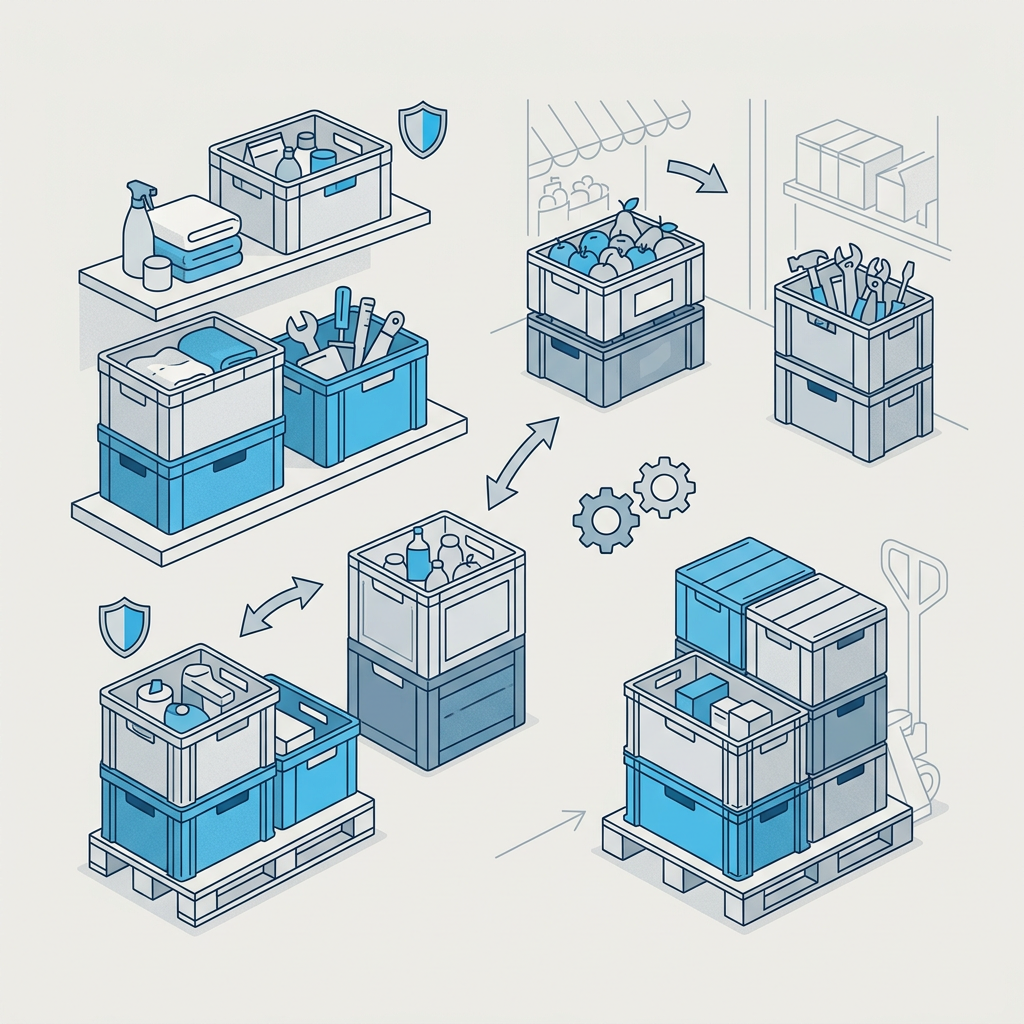
- Stackable Boxes: Designed to be placed one on top of the other without slipping, optimizing vertical space in warehouses and on shelves. They often have reinforced edges or interlocking systems. They are ideal for long-term storage or transporting large volumes.
- Nestable Boxes: Allow empty boxes to be inserted one inside another, significantly reducing volume when not in use. This saves space in return transport and in the storage of empty boxes, being a very efficient solution for closed supply chains or those with reverse logistics.
Boxes with Lids and Security Closures
Maximize space
For warehouses with high product turnover, stackable and nestable boxes are a smart investment to optimize space and reduce logistics costs.
Perforated or Crate Containers
Folding Boxes
Boxes with Compartments and Dividers
Plastic Drawer Unit: Versatile and Economical OrganizationKey Advantages of Plastic Boxes
- Durability and resistance: They are highly resistant to impacts, falls, chemical products, humidity, and temperature variations. This extends their useful life and effectively protects the contents.
- Hygiene and ease of cleaning: Their non-porous surface facilitates cleaning and disinfection, making them ideal for sectors such as food, pharmaceutical, or health.
- Lightness: Despite their robustness, many plastic boxes are considerably lighter than their wooden or metal equivalents, which reduces transport costs.
- Reusability: Designed for multiple use cycles, plastic boxes contribute to the circular economy, reducing waste generation.
- Versatility and adaptability: The wide variety of sizes, shapes, designs (stackable, foldable, with lid, with grates) allows finding the perfect solution for almost any need.
- Content protection: They offer excellent protection against humidity, dust, light, and physical damage, crucial for sensitive products.
Applications and Sectoral Uses
| Sector | Common uses | Preferred box types |
|---|---|---|
| Logistics and Storage | Transport of goods, inventory organization, order preparation. | Stackable, foldable, nestable, with lid and closures. |
| Food and Beverages | Harvest collection, transport of fresh products, cold room storage, packaging for processed products. | Perforated (for ventilation), with airtight lid, stackable, suitable for food contact. |
| Automotive | Component transport, spare parts storage, assembly lines. | Eurobox containers, with dividers, antistatic (for electronic components). |
| Pharmaceutical and Healthcare | Transport of medicines, medical supplies, laboratory storage. | Boxes with lid and seal, stackable, easy to disinfect, with temperature control. |
| Retail | Transport of goods to stores, product display, inventory management. | Foldable (for reverse logistics), with handles, with customization options for branding. |
| Home and Offices | Organization of objects, document storage, moving. | Transparent, with lid, with wheels (for greater mobility), plastic drawer units. |
Food Regulations
In the food sector, boxes must comply with specific food safety regulations, using virgin plastics approved for food contact.
Customization and Accessories
- Colors: Available in a wide variety of colors, which facilitates coding by product type, department, or logistical process.
- Marking and labeling: Possibility of incorporating logos, bar codes, serial numbers, or identification labels through screen printing, laser engraving, digital printing, or label slots.
- Ergonomic handles: Designed to facilitate manual transport, reducing effort and the risk of injury.
- Wheels: Some large box models or drawer units incorporate wheels to facilitate their mobility.
- Dividers and internal trays: Allow organizing and protecting contents, preventing objects from mixing or being damaged.
- Non-slip bases: Improve the stability of boxes, especially in transport environments or on uneven surfaces.
- Connection to transport systems: Some boxes are designed with standard dimensions (e.g., Eurobox) to fit perfectly on pallets or automatic conveyors.
Sustainability and Life Cycle of Plastic Boxes
Reuse
Recycling
Recycled Plastics (PCR)
Plastic Waste Management
Ensure that plastic boxes at the end of their useful life are sent to specialized recycling centers to prevent pollution and promote the circular economy.
Considerations When Choosing Plastic Boxes
- Content type: What will be stored or transported? Is it heavy, delicate, liquid, requires ventilation, or special protection?
- Environment of use: Will it be exposed to extreme temperatures, humidity, chemicals, or direct sunlight?
- Frequency of use: Will it be for one-time use or daily? Will it be constantly reused?
- Storage and transport requirements: Does it need to be stackable, nestable, foldable? Will it be integrated into automated systems or forklifts? What is the available space?
- Capacity and dimensions: It is essential to determine the necessary volume and measurements for the content and available space.
- Budget: Consider the initial investment and long-term cost, including durability and logistics efficiency.
- Sustainability: Evaluate the possibility of using recycled plastics or the recyclability of the material at the end of its useful life.
- Regulations: Ensure that the boxes comply with specific industry regulations (e.g., food contact, safety).