The Manual Pallet Jack: An Essential Tool for Logistics and Goods Transport
In the dynamic world of logistics, efficiency in material movement is a fundamental pillar for the operation of countless businesses. From small warehouses to large distribution centers, the need to move heavy loads from one point to another safely and efficiently is constant. In this context, the manual pallet jack emerges as a robust and versatile solution, indispensable in the daily operations of countless businesses. This basic, yet ingenious, equipment allows for the handling of loaded pallets without requiring complex installations or a large initial investment. Its simple design and ease of use make it the perfect ally for optimizing picking and packing, inventory organization, and shipment preparation, serving as a crucial link in any supply chain.
The Essential
- The manual pallet jack is a fundamental tool for the efficient movement of palletized goods.
- Its simple design and manual operation make it economical, low-maintenance, and easy to use.
- There are various types (standard, scissor, low profile, for rough terrain, stainless steel) adapted to different needs.
- The appropriate choice depends on load capacity, pallet type, working environment, and frequency of use.
Origins of the Pallet
The pallet, invented in the early 20th century, revolutionized logistics by allowing standardized load handling, optimizing transport and storage. The pallet jack emerged as the ideal counterpart for efficiently moving these load units.
What is a manual pallet jack and how does it work?
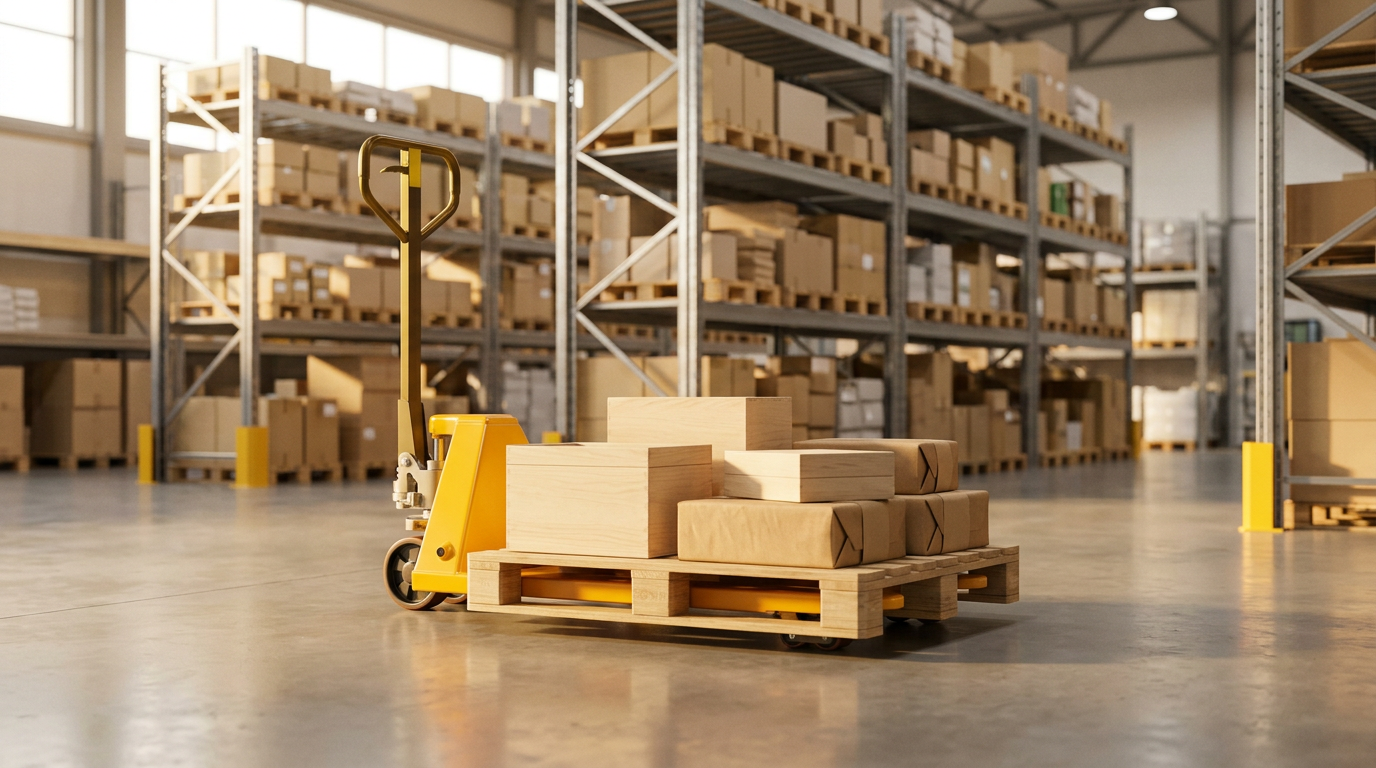
A manual pallet jack, often known as a "hand forklift," is a mechanical device designed to lift and transport pallets. It primarily consists of a chassis with two long forks that slide under the pallet platform, a hydraulic system to lift the load, and a handle with directional wheels for maneuverability. The operator uses the handle to pump the hydraulic system, which raises the forks and, with them, the pallet. Once lifted, the pallet can be moved by pulling or pushing the pallet jack, thanks to its wheels, which are generally made of polyurethane, nylon, or rubber, depending on the surface and the required level of resistance. To lower the load, a lever or trigger on the handle is activated to release the hydraulic pressure.
Types of Manual Pallet Jacks and Their Applications
Although the basic concept is the same, there are several configurations of manual pallet jacks, each adapted to specific needs. Choosing the right type is crucial to ensure efficiency and safety in material handling.
- Standard manual pallet jack: This is the most common and versatile model. Designed to operate with European and American pallets, it offers a load capacity typically ranging from 2,000 to 3,000 kg. It is the preferred option for most warehouses, stores, and truck loading and unloading environments.
- Low-profile pallet jack: Ideal for non-standard pallets or structures with very low entries, such as "skids." Its forks are thinner, allowing access to structures that a standard pallet jack could not.
- Scissor lift pallet jack: Combines the functions of a manual pallet jack with those of a lifting table. It allows the load to be raised to an ergonomic working height (generally up to about 800 mm), reducing the need to bend down and facilitating order preparation or waist-height material handling. It is essential for improving ergonomics and safety in picking and packing tasks.
- Rough terrain pallet jack: Equipped with pneumatic or larger diameter wheels and a reinforced structure, it is designed to operate on uneven surfaces such as construction sites, outdoors, or unpaved floors, where standard pallet jacks would get stuck.
- Stainless steel or galvanized pallet jack: Made with corrosion-resistant materials, it is essential in environments where strict hygiene is required, such as the food, pharmaceutical, or chemical industry, as well as in environments with high humidity or exposure to corrosive agents.
- Weighing pallet jack: Incorporates an integrated scale to weigh the load while transporting it. It is a very useful tool for inventory control, shipment verification, and managing logistics processes where weight is a critical factor.
Manufacturing Materials and Durability
A manual pallet jack is built to withstand intensive use and heavy loads. The materials used in its manufacturing are key to its durability and performance:
- SteelHigh-strength main structure.
- PolyurethaneDurable and quiet wheels.
- NylonWheels for smooth floors.
- RubberWheels with better grip.
- Chrome/GalvanizedCorrosion protection.
The main structure, including the forks and chassis, is usually made of high-quality steel, often powder-coated or painted to resist corrosion and wear. The hydraulic cylinders are usually chrome-plated to prevent rust and ensure smooth sliding. The wheels are a critical component, and their material is chosen based on the type of floor and the working environment:
- Polyurethane: Offers a good balance between abrasion resistance, smooth rolling, and low noise level. Ideal for most warehouses and concrete or resin floors.
- Nylon: Very resistant, hard, and with low rolling resistance, which facilitates the movement of heavy loads. They are ideal for smooth floors but can be noisy and less suitable for uneven floors.
- Rubber: Provide excellent grip and are quiet, but their load capacity is usually lower, and they can wear out more quickly on rough surfaces. They are preferable for delicate floors or where noise minimization is required.
Advantages and Disadvantages of the Manual Pallet Jack
Like any tool, the manual pallet jack has its strengths and limitations.
Advantages:
- Cost-effectiveness: It is one of the most economical solutions for heavy material handling, both in initial investment and maintenance.
- Ease of use: Requires minimal training for operation.
- Low maintenance: Its simple mechanical design means few parts are susceptible to failure and simple maintenance.
- Maneuverability: Its compact size allows it to operate in confined spaces where other machines would not fit.
- Energy independence: Since it does not require a battery or fuel, there is no need to worry about charging or refueling times.
- Versatility: Useful in a wide range of industries and applications.
Disadvantages:
- Physical effort: Requires the operator's strength to move the load, which can be fatiguing with prolonged use or on inclines.
- Height limitation: Only lifts the load enough to move the pallet off the ground, not for stacking or accessing high shelves.
- Reduced speed: The pace of work is significantly slower than that of an electric pallet jack or forklift.
- Risk of injury: Improper use or transport of excessive loads can cause musculoskeletal injuries to the operator.
Ergonomics Tip
To reduce effort and fatigue, consider pallet jacks with low rolling resistance wheels, ergonomic handles, or models with start assistance if you frequently handle particularly heavy loads.
Key Factors When Choosing a Manual Pallet Jack
Selecting the appropriate pallet jack is an investment that directly impacts productivity and safety. Consider the following aspects:
- Load capacity: This is the most important factor. It determines the maximum weight the pallet jack can safely lift. Choose a model with a capacity greater than the average weight of your loads for greater safety and durability.
- Fork dimensions: They must match the dimensions of the pallets to be handled. Standard lengths and widths adapt to European and American pallets. For special pallets, adapted forks are needed.
- Wheel type: As mentioned above, the wheel material (polyurethane, nylon, rubber) is vital depending on the type of floor and the working environment.
- Working environment: Consider if the environment is humid, corrosive, with extreme temperatures, or requires high hygiene. In these cases, stainless steel or galvanized pallet jacks are essential. For uneven floors, specific models are required.
- Frequency and type of use: For occasional use and short movements, a standard pallet jack may suffice. For prolonged picking and packing tasks or handling at different heights, a scissor lift pallet jack improves ergonomics.
- Ergonomics: An ergonomically designed handle, easy lifting and lowering operation, and a good turning radius can improve operator comfort and reduce fatigue.
- Robustness and construction quality: Opt for reputable manufacturers and equipment built with quality materials that guarantee a long service life.
Maintenance and Safety
Proper maintenance extends the life of the manual pallet jack and ensures safe operation. Safety is paramount to prevent accidents and injuries in the workplace.
Maintenance:
- Regular inspection: Periodically check the condition of the wheels, forks, hydraulic cylinder, and handle. Look for signs of wear, damage, or leaks.
- Lubrication: Keep articulation points and wheels well lubricated to ensure smooth movement and reduce wear.
- Hydraulic oil level: Ensure that the hydraulic oil level is correct. Leaks or a low level can affect lifting capacity.
- Cleaning: Keep the pallet jack clean, especially the wheels, to prevent dirt accumulation that could interfere with movement.
Risk of Overloading
Never exceed the rated load capacity of the pallet jack. Doing so can damage the equipment, compromise load stability, and cause serious accidents to the operator or nearby personnel.
Safety:
- Training: All operators must receive training on the correct and safe use of the pallet jack.
- Pre-use inspection: Before each operation, the operator must perform a visual inspection of the pallet jack.
- Balanced load: Ensure that the load is centered and stable on the pallet before moving it. Do not transport excessively protruding loads.
- Visibility: Always maintain good visibility of the path. If the load obstructs the view, move it by pushing from behind.
- Controlled speed: Move the pallet jack at a speed that allows it to stop safely at any time. Avoid abrupt movements.
- Surface: Operate on level surfaces free of obstacles. Slopes must be approached with caution, always moving the pallet jack so that the load is below the operator.
- Safety distance: Maintain a safe distance between the pallet jack and other people or objects.
Innovations and Trends
Although the manual pallet jack is a tool with a consolidated design, the constant search for efficiency and concern for safety have driven some innovations:
- Lighter and stronger materials: The use of high-strength steels and special alloys makes it possible to reduce the weight of the pallet jack without compromising its load capacity, making handling easier.
- Anti-overload systems: Some pallet jacks incorporate systems that prevent the lifting of loads exceeding the nominal capacity, preventing damage and accidents.
- Dual wheels and entry/exit rollers: Dual wheels on the forks better distribute the weight, while entry and exit rollers facilitate access and removal of pallets, especially in the blind holes of some pallets.
- Semi-electric pallet jacks: Although not purely manual, they represent an interesting hybrid where load lifting is still manual, but traction is electric, significantly alleviating the physical effort of the operator in long movements.
- Connectivity (in weighing pallet jacks): Some models of weighing pallet jacks can integrate Bluetooth or Wi-Fi connectivity to send weight data directly to warehouse or inventory management systems, optimizing traceability.
Final Considerations for Acquisition
When considering the acquisition of a manual pallet jack, it is essential to evaluate not only the initial price but also the quality of the components, the availability of spare parts, and after-sales service. A good quality manual pallet jack is a long-term investment that will guarantee the safety of operations and efficiency in material flow. Always prioritize safety and ergonomics to protect operators and ensure a healthy working environment. Exploring a catalog of wooden boxes or other packaging, for example, can help visualize the interaction between the pallet jack and the goods to be transported.